Showing posts with label education. Show all posts

Monday, November 1, 2021

Sources of Strength for Regenerative Teaching and Learning 2: Intimations of the Ecopsychology of Deeper Learning

Given that educators have a desire to support students deepening beyond surface curiosity to deeper learning, what can ecopsychology offer?  What might deeper learning look like, including in online learning contexts?

As a follow-up to a recent post about grappling with grief as a way through to shifted perspectives and greater empathy, including grappling with Earth grief, I want to open an exploration of deeper learning. I noticed in two current online course discussions, how students can move towards convivial kibbitzing and avoid deeper lines of inquiry. 

 Is this because of a tension between relationship building and a fear of online attack, particularly because of intersectional dynamics with fewer interpersonal cues, including along dimensions of genders, sexualities, and social constructions of race? In feminist education this has sometimes been termed a "cozy" environment. We can all stay safe by agreeing, right? Here's a few online social technologies that can open things up:

  • Brave space guidelines can open up discussions (Backgrounder: Arao & Clemens, 2013; Guidelines for Brave Communication (AWARE-LA, n.d.)
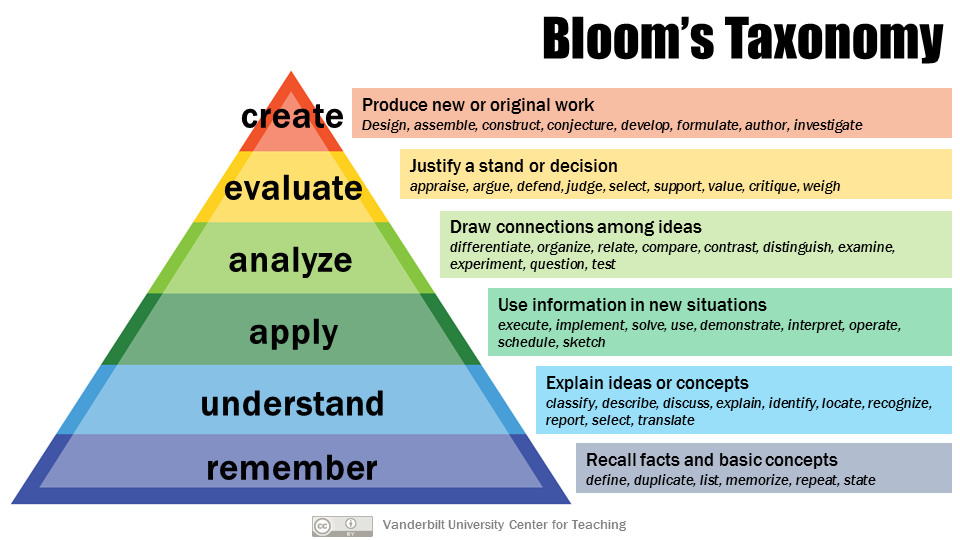
  • Approaches that elicit deeper, creative and evaluative critical and innovative thinking, leveraging the inversion of Bloom's Taxonomy such that creative work is the zenith; its horizontalization in the Bloom's Rose (see Figure 2), applied to thinking and learning


Source: Vanderbilt University Center for Teaching, 


Source: Education Endowment Foundation (2018, 2021) - Source Page


Francis, 2016 - Source Article

Supporting students being metacognitive in their own teaching and learning has profound gains. I can model and encourage learners to dig deeper to ask creative questions (see EEF, 2021 Diagram above). These creative questions can catalyze mutual inquiries - very useful in generating deeper conversations. 
 
What might be an ecopsychological dimension to these questions that can take us deeper? I wonder how nimble perspective shifting, lithe creativity, and compassion sourced from the wellspring of ecoconnection and ecojustice ethics might support this deepening as well. How can we  with resilience. Perhaps we can apply these principles from Earthflow (Hauk, 2014, p. 361) to our shared explorations ...


Monday, December 30, 2013

Incubating Social Creativity and Regenerative Creativity

T. Fisher photo of Stancell's Mural "We Who Believe in Freedom Cannot Rest"
The fields of social learning and social incubators are cultivating, I would suggest, the endeavor of incubating social creativity.

Social Learning. Wals and Leij (2007) in their prefatory remarks to a book on the topic of social learning and sustainability education (free downloadable ebook available) point out the spectrum of meaning for social learning --  from learning among deeply socially contexted inviduals to focusing on the learning processes of 'social aggregates' (pp. 19-20). They suggest that social learning involves facilitating dynamic contexts for richly socially contexted, diverse groups to engage with sustainability challenges along this spectrum. Complexivists have referred to this as extending the locus of learning to the learning community [and not (only) the individual] (Davis & Sumara, 2006) or as the learning of collective beings (Minati & Pessa, 2006). Sterling (in the 2007 volume linked above) imagines a "connective cultural consciousness" in which sustainability social learning can help cultures "ride the storm" of climate change by undertaking radical social learning at the scale of paradigm change.

Granted, these ideas of social collectives are not actually novel. To note, elder cultures (such as those featured by Bowers' scholarship on the learning commons and traditional cultures) have long understood that learning communities offer a deep connection, empowerment, and nurture than individuals operating in isolation or even individuals collaborating.  Educational theory is still catching up.

At the same time that learning theory is learning to jump scales and study aggregates, enterprise theory and incubation of entrepreneurship (and ecopreneurship even) is undergoing a similar shift from rugged individualism to .... social incubators.


Social Incubators. Social media, crowdfunding, honoring social good and values-infused endeavor, and open-sourcing as well as increasingly accessible organizational infrastructure through internet technologies have radically opened the field of enterprise innovation. The idea of separate "enterprises" are themselves melting as densely interconnected networks of creatives and service brocades transfigure entrepreneurship. The rise of social enterprise incubators (also these examples) and the generosity economy all reflect a parallel to the shift described in educational theorizing toward attending to the social dimensions of learning and social learning. 


Incubating Social Creativity. Without falling into the western tendency to reify the new (as is often the case in unconscious neophilia), the social evolution of our species involves attending to complex emergence. Our culture is evolving to attend to emergence, autopoiesis, and self-organization as signs of complex innovation and novelty.  Goldstein, Hazy, and Lichtenstein (2010) propose complexity-informed strategies for facilitating ecologies of innovation. 

Attending to innovation in a deep sense means attending to creativity. Csiksentmilhalyi (1999) noticed how the systems of field and culture contexted and vetted individual creativity. R. Keith Sawyer (2010) takes off from jazz improvisation to develop a complexity-informed social creativity called collaborative emergence. In collaborative emergence, creative collaborations by groups of people spark emergent phenomena at the group scale. Ecologies of innovation extend this emergent process to locality and cultural scales, even innovating public services (for example in Peterborough). At the scale of locality and neighborhood, the Transition Town movement exemplifies this shift; City Repair and Placemaking serves as another beacon. Social creativity has been credited with rapidly accelerating software innovation (Granof, 2013). Many other theorists have also explored social creativity (including John-Steiner, 2000 and Sawyer, 2008). Social as a descriptor in social creativity can function in two ways, either to convey that the phenomena is generated by social aggregate or that it is geared toward social good.

Researching Incubating Social Creativity. My original mixed methods research is surfacing methods and means for catalyzing social creativity. I research the "social" in creativity across both dimensions of meaning of social: (1) that it is generated by groups and systems of creativity and (2) that it has an intention toward social good, in this case sustainability and regeneration.

I am studying how to incubate multi-scale creativity. By generating processes, habits of curiosity, and cultures of individual and small group creative processes as well as setting up learning cultures favoring social creativity, we can facilitate and encourage the underlying practices, habits, and cultural matrix to nurture social creativity.

The research is surfacing how creativity, the seedbed for innovation and personal and cultural flourishing, can be sourced in nature and bioculture and aligned with increasing the integrity of culture, place and planet. This regenerative creativity emerges at multiple scales and produces empathy, connection, and earth-aligned action. Incubating social creativity catalyzed by ecofractal patterns from nature and bioculture develops what Bowers (2012) calls ecological intelligence and what Goleman, Bennett & Barlow (2012) name ecoliteracy, an emotionally and socially engaged ecological intelligence.  I would suggest that to incubate this kind of regenerative cultural and social creativity can source shifts not only in social learning and social enterprise, but also in multiple other domains and transdisciplines as part of the enlarging and interconnecting tapestry of cultural regeneration beyond sustainability to thriving.

In the coming months we will be sharing snapshots of the emergent findings from this research.

Resources
  • Bowers, C. A. (2012). The challenge facing educational reformers: Making the transition from individual to ecological intelligence in an era of climate change. In D. Ambrose & R. J. Sternberg (Eds.), How dogmatic beliefs harm creativity and higher-level thinking (pp. 112-122). New York, NY: Routledge, Taylor & Francis.
  • City Repair. (2013). Website. Retrieved from http://www.cityrepair.org
  • Csikszentmihalyi, M. (1999). Implications of a systems perspective for the study of creativity. In R. J. Sternberg (Ed.), Handbook of creativity. New York, NY:
    Cambridge University Press.
  • Dawson, J. (2012). Building an economy on gift and generosity [Blog post]. Retrieved from http://www.schumachercollege.org.uk/blog/building-an-economy-on-gift-and-generosity-jonatha-dawson
  • Goldstein, J., Hazy, J. K., & Lichtenstein, B. B. (2010). Complexity and the nexus of leadership: Leveraging nonlinear science to create ecologies of innovation. New York, NY: Palgrave Macmillan.
  • Goleman, D., Bennett, L., & Barlow, Z. (2012). Ecoliterate: How educators are cultivating emotional, social, and ecological intelligence. San Francisco, CA: Jossey-Bass and the Center for Ecoliteracy.
  • Granof, P. (2013, October 9). Social creativity: The engine of software development [Blog post]. Wired - Innovation Insights. Retrieved from http://www.wired.com/insights/2013/10/social-creativity-the-engine-of-software-development-in-the-social-era/
  • Sawyer, R. K. (2008). Group genius: The creative power of collaboration. New York, NY: Basic. 
  • Sawyer, R. K. (2010). Individual and group creativity. In J. C. Kaufman & R. J. Sternberg (Eds.), The Cambridge handbook of creativity (pp. 366-380). New York, NY: Cambridge University Press.
  • Stancell, P. Mural of "We who believe in freedom cannot rest." On Wikimedia Commons. Mural on the wall of row houses in Philadelphia, sponsored by the Freedom School Mural Arts Program.
  • Transition Network. (2013). Website.  Retrieved from http://www.transitionnetwork.org/
  • Wals, A. E. J. (Ed.). (2007). Social learning towards a sustainable world: Principles, perspectives, and praxis. Pays-Bas: Wageningen Academic Publishers. Retrieved from the publisher at http://www.wageningenacademic.com/sociallearning 
Image Credit: 

Photograph by Tom Fischer, 2009, of a Mural on the wall of row houses in Philadelphia. Mural Artist is Parris Stancell, sponsored by the Freedom School Mural Arts program. Photo Creative Commons 2. Left to right: Malcolm Shabazz (Malcolm X), Ella Baker, Martin Luther King, Jr., Frederick Douglass. The quote above the mural is from Ella Baker, a founder of SNCC (Student Non-Violent Coordinating Committee), a civil rights group that helped to coordinate "Freedom Rides" in the early 1960's (from Wikimedia Commons).

Thursday, October 20, 2011

Creativity


Ken Robinson, in his February 2006 TED Talk (available here), challenges us to redesign education to nurture and support creativity. Here's some snapshots of his great talk. "Does School Kill Creativity?"

Children - Capacity for Innovation

"All kids have tremendous talents and we squander them, pretty ruthlessly."
"My contention is that creativity now is as important in education as literacy and we should treat it with the same status."

Creativity Requires the Space to Make Mistakes

“Kids will take a chance. If kids don't know, they will take a go, they aren't afraid of being wrong.”
"If you're not prepared to be wrong, you will never come up with anything original."

In our culture now, adults stigmatize mistakes. "We are educating people out of their creative capacities."

"We don't grow into creativity, we get educated out of it."

Imagine Shakespeare as a Child
We don't think of Shakespeare being a child. Ken lived near where Shakespeare's father lived.
“Shakespeare was in someone's English class. Imagine Shakespeare as a child. 'Go to bed now. Put the pencil down and stop speaking like that.'”

Against the Arts at the Bottom of the Hierarchy of Subjects, Critique of Industrial Education as Reproducing Lopsided and Disembodied Head-Focused Experience

Robinson argues against the current hierarchy of subjects. Reading Math, then Humanities, then the Arts. Within the arts, there's a hierarchy. art and music higher status drama, dance

"There's no school system that teaches dance everyday. We all have bodies, did I miss a meeting. As children grow up, we educate them progressively from the waist up, and then we focus on their heads, and slightly to one side. If we were to visit education as an alien and ask what is it for, you'd have to conclude the whole purpose of public education throughout the world is to produce university professors, they're the people who come out on the top. We should not hold them up as the high water mark of all human achievement, they are just another form of life. They live in their heads, up there and slightly to one side. They are disembodied. They look at their body as a form of transport for their heads. It's a way of getting their head to meetings."

"Our education system was ... to meet the needs of industrialism. Most useful subjects are at the top. Don't do music, you won't be a musician. Now profoundly mistaken. Second is, academic ability. academic intelligence. The whole system is a protracted entrance exam to university."

“In the next 30 years, more people will be graduating from education than any time in history. Suddenly, degrees aren't worth anything….Before, if you had a degree and if you didn't have a job, it's because you didn't want one.” Now you need a higher and higher one- whole structure changing.

Intelligence is Diverse, Dynamic, and Distinct
"We need to radically rethink our understanding of intelligence. .... It's diverse. Secondly, it's dynamic. Intelligence is wonderfully interactive. Creativity is the process of having original ideas that have value." It comes because of going across disciplines (13:50). "The third thing about intelligence is that it's distinct."

Dancer, not Deficient
Story about Dancer [now captured in his book, The Element (2009)], GIllian Lynne was sent to a specialist because the school suspected a learning disorder, when the doctor figured out, she was a dancer. "'Mrs. Lynne, Gillian isn't sick, she's a dancer.'" Gillian was able to attend dance school and eventually choreographed Cats and Phantom of the Opera.

A New Human Ecology Based on Building Human Capacity
"Al Gore spoke the other night about ecology and the revolution that was triggered by Rachel Carson. I believe our only hope for the future is to adopt a new conception of human ecology, one in which we start to reconstitute our understanding of human capacity. Our education system has mined our minds in the same way we've strip mined the Earth, for a particular commodity. And for the future, it won't serve us. We have to rethink the fundamental principles on which we're educating our children."

Need to Re-aim Education at Creativity to Change Human Planetary Presence for Healing/Generative Purposes
 "Jonas Salk...said, 'if all the insects were to disappear from the earth, within 50 years, all life on earth would end. If all human beings disappeared from the earth, all forms of life on earth would flourish.' And he's right."

Celebrating the Human Imagination
"What TED celebrates is the gift of the human imagination. We have to be careful now that we use this gift wisely and that we avert some of the scenarios we've heard about. The only way we'll do it is to see our creative capacities for the richness that they are and understand seeing our children for the hope that they are. And our task is to educate their whole being so that they can face this future. By the way, we might not see this future, but they will. And our job is to help them make something of it."

Wednesday, February 16, 2011

Pedagogy of Place and Poetry in Nature Rewilding Learners

Reflection – Marna Hauk - Sense of Wonder and Earth in Mind – Pedagogy of Place

"To see what is here, right in front of us: nothing would seem easier or more obvious, yet few things are more difficult. There are unmistakable signs that something may be dying among us: that capacity to see the world, to recognize the 'other' and admit it into our lives. Invisible walls shut us out, or shut us in, and we make them stronger and thicker by the day."

- John Haines, Living off the Country, p. 17

In Living off the Country, John Haines describes a possibly dying capacity amongst humans to experience the world deeply and connect. Haines focuses on the role of the poet to resuscitate a capacity of seeing and a culture of connection. In as much as educators are like poets, he is also describing a revitalizing pedagogy of place. Rachel Carson, Wendell Berry, E. O. Wilson, and David Orr all confirm the essential elements of this sensory opening and connection with place.

The capacity to wonder sparked by intimate experiences with place sources both poet and scientist. E. O. Wilson argues in "The Poetic Species" (Biophilia, 1984) that poets, like scientists, are engaged in enterprises of discovery bound by our relationship to other organisms (p. 63), founded in love and childhood fascination, providing a lodestar and sanctuary (p. 65). In other words, love and connection are the bases of poetry and science. And education that awakens this love and connection revitalizes our humanness.

The capacity is within us, it is in-built, this sense of wonder, this capacity to deeply notice. E. O. Wilson and Carson agree about the central role of a sense of discovery. For Carson, informal and direct primary experience and discovery nourish the sense of wonder. Carson (1998) confirms that a sense of meeting the unknown with primary senses, and having someone to share the experience with, are the critical process. "The sharing includes nature in storm as well as calm, by night as well as day, and is based on having fun together rather than on teaching" (p. 17). Shared informal and primary sensory experience and discovery can be exhilarating: "just going through the woods in the spirit of two friends on an expedition of excited discovery" (p. 23)

Educators, like poets, break down the walls that have been built up against primary perception and discovering a sense of wonder. Orr affirms that biophilia and a sense of mystery are connected (2004, p. 138). Haines articulates how by becoming connected with place, places can speak through us—by becoming authentic and connected, the voice of the place can enter our work:


"What counts finally in a work are not novel and interesting things, though these can be important, but the absolutely authentic. I think that there is a spirit of place, a presence asking to be expressed; and sometimes when we are lucky as writers, and quiet in a way few of us want to be anymore, a voice enters our own…I have come to feel that there is here in North America a hidden place obscured by what we have built upon it, and that whenever we penetrate the surface of the life around us that place and its spirit can be found." (Haines)

How can we design, provoke, and/or encourage learning experiences that allow "the hidden place" below the surface to emerge in us, in writing and in life? Berry suggests that Haines points us towards a focus on authenticity and connection: "Once a place and its spirit have become not just subjects but standards of the writer's work, then the connections between art and community, art and tradition, art and thought become necessary and clear" (2010, pp. 52-53). Berry argues that cultivating this sense of connectedness also saves us from "the shrinkage of the world to the limits of the isolated, displaced, desiring, and despairing self" (p. 53), bringing us to realize Orr's values, consciousness, questions, and conscience (2004, p. 8). Andrea Olsen in Body and Earth encourages a process of direct engagement and what she calls inclusive attention before writing and reflection, "valuing experience as well as the language used to describe it" (2002, p. 5). Carson describes this as "expressing pleasure in what we see, calling his attention to this or that but only as I would have shared discoveries with an older person" (p. 23) As Orr expresses, "True intelligence is long range and aims towards wholeness" (Orr, p. 11).

These scholar-practitioners provide insights into how to reconnect and increase what I term Earth empathy (see www.earthregenerative.org/earth-empathy/homepage.html), the capacity for humans to connect with the larger presence of the life of the planet in a deeply meaningful way. Fostering and encouraging earth empathy is a critically important fruit of emplaced learning. Complexity science, with its understanding of emergent properties arising greater than the sum of parts helps us understand how fostering a Gaian connectedness, an Earth empathy, can help connect humans with the larger living presences of which we are a part – place and planet.

One way to apply these insights regarding a sense of wonder and education that keeps Earth in mind takes inspiration from the field of poetry therapy and poetic medicine. By creating collegial experiences of direct sensory experience and discovery as well as writerly reflection, I have witnessed awakenings with groups across ages. Whether with kindergarteners in a school courtyard opening up to the happenings of a blossoming jacaranda, with middle-schoolers getting their feet muddy at a cob building site and habitat restoration, or with adults in deep forest, direct experience with spacious nature opens and connects. Poetic processes and writing integrated with these experiences help learners track the path of their own discoveries, offers a wider language for their expanded perceptions, and allows them to become metacognitively capable of continuing connection. We become, at least for a time, re-wilded.

References

Berry, W. (2010). Imagination in place: Essays. Berkeley: Counterpoint.

Carson, R. L., & Kelsh, N. (1998). The sense of wonder. New York: HarperCollins Publishers.

Haines, J. (1981). Living off the country: Essays on poetry and place. Ann Arbor: U of Michigan Press.

Kellert, S. R. & Wilson, E. O. (Eds.). (1993). The biophilia hypothesis. Washington D.C.: Island Press.

Olsen, A. (2002). Body and Earth: An experiential guide. Lebanon, NH: U Press of New England.

Orr, D. (2004). Earth in mind: On education, the environment, and the human prospect. Washington DC: Island Press.

Wilson, E. O. (1984). Biophilia. Cambridge, Mass: Harvard University Press.
Sunday, November 28, 2010

A Day of Poetry and the Language of the Earth

Here are some of the books and readings I have been savoring today while exploring ideas of earth regenerative education design:
• Abram, D. (2010). Becoming animal: An earthly cosmology. New York: Pantheon Books.
• Berry, W. (2010). Imagination in place: Essays. Berkeley, CA: Counterpoint.
• Berry, W. (2010). Leavings: Poems. Berkeley, CA: Counterpoint.
• Dillard, A. (1982). Teaching a stone to talk: Expeditions and encounters. New York: Harper & Row.
• Haines, J. M. (1981). Living off the country: Essays on poetry and place. Ann Arbor: University of Michigan Press.

Here are some of the quotes that sparked me during these readings:

David Abrams in his new book Becoming Animal: An Earthly Cosmology, in his chapter on "The Speech of Things":
  • Abrams on Gaia:

    "An eternity we thought was elsewhere now calls out to us from every cleft in every stone, from every cloud and clump of dirt. To lend our ears to the dripping glaciers—to come awake to the voices of the silence—is to be turned inside out, discovering to our astonishment that the wholeness and holiness we'd been dreaming our way towards has been holding us all along, that the secret and the sacred One that moves behind all the many traditions is none other than this animate immensity that enfolds us, this spherical eternity, glimpsed at last in its unfathomable wholeness and complexity, in its sensitivity and its sentience." David Abram, 2010, Becoming Animal: An Earthly Cosmology, pp. 180-181

  • Abrams on Speech and Embodiment:

    167 "My encounter with the sea creatures had initiated me into a layer of language much older, and deeper, than words. It was a dimension of expressive meanings that were directly felt by the body, a realm wherein the body itself speaks—by the tonality and rhythm of its sounds, by its gestures, even by the expressive potency of its poise….an older, animal awareness came to the fore, responding spontaneously to the gestures of these other animals with hardly any interpolation by my 'interior' thinking mind. It was rather as if my body itself was doing the thinking, trading vocal utterances and physical expressions back and forth with these other smooth-skinned and sentient creatures."


  • 167 (bottom) "To the fully embodied animal any movement might be a gesture, and any sound may be a voice, a meaningful utterance of the world. And hence to my own creaturely flesh, as well, everything speaks!"


  • 168 "this animal dimension of my own speaking…the gruff or giddy melody that steadily sounds through my phrases, and the dance enacted by my body as I speak—the open astonishment or slumped surrender, the wary stealth of the lanky ease. Trying to articulate a fresh insight, I feel my way toward the precise phrase with the whole of my flesh, drawn toward certain terms by the way their texture beckons dimly to senses, choosing words by the way they fit the shape of that insight, or by the way they finally taste on my tongue as I intone them one after another. And the power of that spoken phrase to provoke insights in those around me will depend upon the timbre of my talking, the way it jives with the collective mood or merely jangles their ears."


  • 172-3 "It follows that the myriad things are also listening or attending to various signs and gestures around them. Indeed, when we are at ease in our animal flesh, we will sometimes feel that we are being listened to, or sensed, by the earthly surroundings. And so we take deeper care with our speaking, mindful that our sounds may carry more than a merely human meaning and resonance. This care—this full-bodied alertness—is the ancient, ancestral source of all word magic. It is the practice of attention to the uncanny power that lives in our spoken phrases to touch and sometimes transform the tenor of the world's unfolding."


  • 173 "sense of inhabiting an articulate landscape—of dwelling within a community of expressive presences that are also attentive, and listening, to the meanings that move between them—is common to indigenous, oral peoples on every continent."


  • 175: "Yet if we no longer call out to the moon slipping between the clouds or whisper to the spider setting the silken struts of her web, well, then the numerous powers of this world will no longer address us—and it they still try, we will not likely hear them. They withdraw from our attentions, and soon refrain from encountering us when we're out wandering, or from visiting us in our dreams. We can no longer avail ourselves of their perspectives or their guidance, and our human affairs suffer as a result. We become ever more forgetful in our relations with the rest of the biosphere, an obliviousness that cuts us off from ourselves, and from our deepest sources of sustenance."

  • "We now know, however, that the tangible world is itself such an iridescent sphere turning silent among the stars, a round mystery whose life is utterly eternal relative to ours, from out of whose vastness our momentary lives are born, and into whose vastness our lives—like those of our ancestors, our enemies, and our children—all recede, like waves on the surface of the sea." (p. 180)


Wendell Berry on Poetry and Silence:

  • Section 8, 2008 - Untitled, from Leavings

    Poem, do not raise your voice.

    Be a whisper that says "There!"

    where the stream speaks to itself

    of the deep rock of the hill

    it has carved its way down to

    in flowing over them. "There!"

    where the sun enters and the tanager

    flares suddenly on the lighted branch,

    "There!" where the aerial columbine

    brightens on its slender stalk.

    Walk, poem. Watch, and make no noise.


    Wendell Berry

    Leavings, 2010, p. 95


Wendell Berry on Speech and Silence:

  • Essay: "Speech after Long Silence" (1994) appearing in

    Berry, W. (2010). Imagination in place: Essays. Berkeley, CA: Counterpoint.

    "The explainers of language of poetry will be forever embarrassed, I hope, by the experience of readers of poetry: Poems tell more than they say. They convey, as if mutely, the condition of the mind that made them, and this is a large part of their meaning and worth. Mr. Haines' poems, as I heard them that evening, told that they were the work of a mind that had taught itself to be quiet for a long time. His lines were qualified unremittingly by a silence that they came from and were going toward, and that for a moment broke. One felt that the words had come down onto the page one at a time, like slow drops from a dripping eave, making their assured small sounds, the sounds accumulating. The poems seemed to have been made with a patience like that with which rivers freeze or lichens cover stones. Within the condition of long-accepted silence, each line had been acutely listened for, and then acutely listened to." (Berry, 2010, pp. 49-50)

    "The attendant silence thus becomes the enabling condition of a kind of language and a kind of knowledge." (p. 51)

Annie Dillard on the Vibrant Silence of Nature:
  • Dillard, A. (1982). Teaching a stone to talk: Expeditions and encounters. New York: Harper & Row.

  • "it is difficult to undo our own damage, and to recall to our presence that which we have asked to leave. It is hard to desecrate the grove and change your mind. The very holy mountains are keeping mum. We doused the burning bush and cannot rekindle it; we are lighting matches in vain under every green tree. Did the wind used to cry, and the hills shout forth praise? Now speech has perished from among the lifeless things of earth, and living things say very little to very few. Birds may crank out sweet gibberish and monkeys howl; horses neigh and pigs say, as you recall, oink oink. But so do cobbles rumble when a wave recedes, and thunder breaks the air in lightning storms. I call these noises silence. It could be that wherever this is motion there is noise, as when a whale breaches and smacks the water—and wherever there is stillness there is the still small voice, God's speaking from the whirlwind, nature's old song and dance, the show we drove from town. At any rate, now it is all we can do, among our best efforts, to try to teach a given human language, English, to chimpanzees…" (p. 88)


  • "At a certain point you say to the woods, to the sea, to the mountains, to the world, Now I am ready. Now I will stop and be wholly attentive. You empty yourself and wait, listening. After a time you hear it: there is nothing there. There is nothing but those things only, those created objects, discrete, growing or holding, or swaying, being rained on or raining, held, flooding or ebbing, standing, or spread. You feel the world's word as a tension, a hum, a single chorused note everywhere the same. This is it: this hum is the silence. Nature does utter a peep—just this one. The birds and insects, the meadows and swamps and rivers and stones and mountains and clouds: they all do it; they all don't do it. There is a vibrancy to this silence, a suppression, as if someone were gagging the world. But you wait, you give your life's length to its listening, and nothing happens. The ice rolls up, the ice rolls back, and still that single note obtains. The tension, or lack of it, is intolerable. The silence is not actually suppression; instead, it is all there is." Dillard, pp. 89-90

  • p. 94: "The silence is all there is. It is the alpha and the omega. It is God's brooding over the face of the waters; it is the blended note of the ten thousand things, the whine of wings. You take a step in the right direction, to pray to this silence, and even to address the prayer to "World." Distinctions blur. Quit your tents. Pray without ceasing."

This passage from Haines reminded me of Craig Chalquists's work in Terrapsychology (such as in Chalquist, C., & Gomes, M. E. (2007). Terrapsychology: Re-engaging the soul of place. New Orleans: Spring Journal Books. ):
  • Haines, J. M. (1981). Living off the country: Essays on poetry and place. Ann Arbor: University of Michigan Press.


which Berry had quoted in his Imagination in Place essay on "Speech After Long Silence":

  • "What counts finally in a work are not novel and interesting things, though these can be important, but the absolutely authentic. I think that there is a spirit of place, a presence asking to be expressed; and sometimes when we are lucky as writers, and quiet in a way few of us want to be anymore, a voice enters our own…I have come to feel that there is here in North America a hidden place obscured by what we have built upon it, and that whenever we penetrate the surface of the life around us that place and its spirit can be found."

Saturday, April 10, 2010

Tragic Close of SUNY Southhampton Eco-Campus

Commemorating the work of my colleague Aimee DeChambeau to create human-scale education at SUNY. The SUNY Southhampton campus will be closed due to budget cuts and reopened as a massive commuter school.

So sad to see all that love and design not be able to immediately be a resource to the next generation - I wonder if there were a way to turnaround the campus instead so it could be a profit center for SUNY (not only tuition --but also/instead, produce and products, innovation center)....

In terms of some models for higher education...

Fractal/complexity/emergence science offers more scalable and fleet footed models than these large organizations with so much middle management freight. It shows how sustainability is not only about the "how" of physical infrastructure but also the "how" of scales and power structures. What is at the heart of a school? Is it a campus? Is it about a rendering of 17th/18th century mansions/palaces/ with large lawn expanses and the caricature-ization of the leisure class (which by the way implies a servant/slave class, see Rosemary Radford Ruether/I'll save the rest of this rant) or is it more like a working class/productive farm/garden/food forest? with mentoring and apprenticeships, embedded in the community. What about education "booths" or "observation pods" (stations) in public parks? What about bunkhouses, backpacks and distributed computing while tending the geese and llamas instead of all this overhead of large buildings where people can sit inside in regal/majestic courts, completely divorced from weather elements, sometimes without sky? What about goatbarn roundtables while pulling beans?

Wednesday, February 17, 2010

Who or what carries the lost wisdom?

About the Bari people, described in Ethnobotany and Conservation of Biocultural Diversity (Carlson and Maffi, 2004)

For now, and for the time to come when the wisdom is even more scattered to the winds, what do you think happens to that knowing? Do the trees carry it? Is it only alive while the Bari elders are alive, in the interactions/relations of the trees and the people? Or is it held by the Earth somehow? By the ancestors of the Bari who have passed? Or perhaps in the bodies or epigenetically or in the field of the Bari progeny?

Sometimes I think the air, every molecule that was ever a tree or Bari or the light that passed through a chloroplast, is quivering with this multigenerational knowing. Is this what sustainability education is, to re-member how to access this knowing?

This seems to me to be the greatest loss, the languages that have passed into air and branch, the biocultural, co-evolutionary complexity. The peoples whose millenial ways have passed through tortuous means from the vital living cultures of Earth. Is there some way we can summon the knowing in this time when wisdom, particular, specific, clarion, could help guide us?