Showing posts with label 6x16. Show all posts

Tuesday, November 16, 2021

Envisioning Educating-With - and Supporting the Detox of Dependency in Learners to Nurture Ecofractal Networks of Interconnected Imagination

Grading and evaluation are troubling topics in regenerative education. If we are deeply committed to students moving from intrinsic motivation, interest, and curiosity, yet teach within dominant-culture organizations, what are we to do? 

Students have been enculturated in external locus of control evaluation. I'm teaching a class right now where the students develop their own rubrics for deep self-evaluation. Yet some students continue to not show up as much as they would, not contribute as much as they would than if every discussion and activity had specific points associated with it. The reductionism, hierarchy, and externalization of value intrinsic to dominator culture education structures would tend toward classrooms of dis-integrated nodes of action that can be independently enumerated. 

I imagine co-designing with students a detox regimen where they can reorient around intrinsic motivation and geared toward interconnective co-creative explorations.  

Artwork by Barbara Wildenboer (Link)

In kinds of regenerative education informed by power-with, we might instead envision eddies and flows of integrating discussion across multiple activities and readings, and a connectivist ethos of collaborative inquiry. I fantasize mycelial rubrics of connection and collaboration and mutual making. How can we co-generate networks of fresh connection and co-nurturing extensions of knowledge? ...And what software, rather than the hyperstructure of Canvas or the dungeons of diffraction in Moodle, might support such network making? A mashup of decentered mindmapping and rich media? Perhaps with "scores" for fluidity, flexibility, originality, and elaboration? Via citations, quotes at nodes, plus rich multimedia content, original drawings at nodes? And what about metapatterns of an ecofractal nature rather than simple radiance? A regenerative educator can always dream...


Monday, November 1, 2021

Sources of Strength for Regenerative Teaching and Learning 2: Intimations of the Ecopsychology of Deeper Learning

Given that educators have a desire to support students deepening beyond surface curiosity to deeper learning, what can ecopsychology offer?  What might deeper learning look like, including in online learning contexts?

As a follow-up to a recent post about grappling with grief as a way through to shifted perspectives and greater empathy, including grappling with Earth grief, I want to open an exploration of deeper learning. I noticed in two current online course discussions, how students can move towards convivial kibbitzing and avoid deeper lines of inquiry. 

 Is this because of a tension between relationship building and a fear of online attack, particularly because of intersectional dynamics with fewer interpersonal cues, including along dimensions of genders, sexualities, and social constructions of race? In feminist education this has sometimes been termed a "cozy" environment. We can all stay safe by agreeing, right? Here's a few online social technologies that can open things up:

  • Brave space guidelines can open up discussions (Backgrounder: Arao & Clemens, 2013; Guidelines for Brave Communication (AWARE-LA, n.d.)
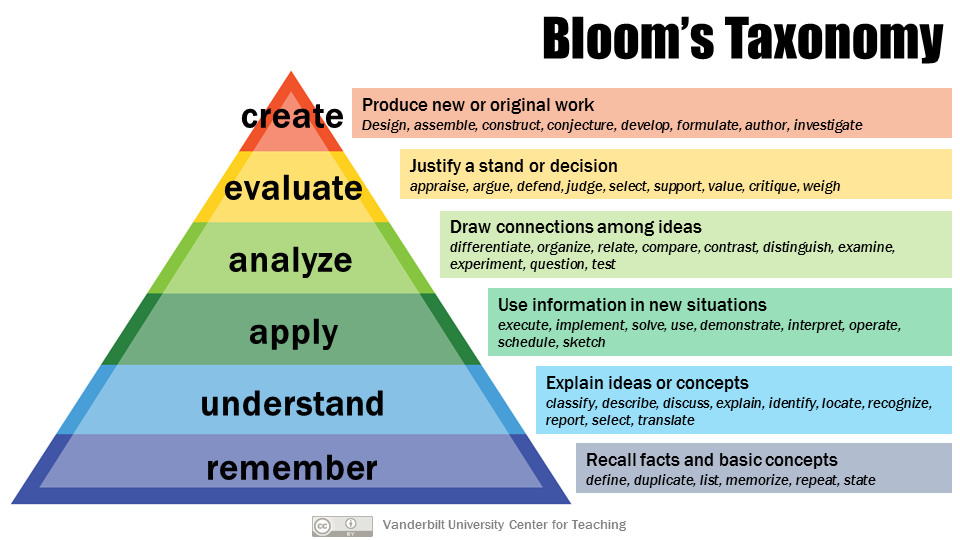
  • Approaches that elicit deeper, creative and evaluative critical and innovative thinking, leveraging the inversion of Bloom's Taxonomy such that creative work is the zenith; its horizontalization in the Bloom's Rose (see Figure 2), applied to thinking and learning


Source: Vanderbilt University Center for Teaching, 


Source: Education Endowment Foundation (2018, 2021) - Source Page


Francis, 2016 - Source Article

Supporting students being metacognitive in their own teaching and learning has profound gains. I can model and encourage learners to dig deeper to ask creative questions (see EEF, 2021 Diagram above). These creative questions can catalyze mutual inquiries - very useful in generating deeper conversations. 
 
What might be an ecopsychological dimension to these questions that can take us deeper? I wonder how nimble perspective shifting, lithe creativity, and compassion sourced from the wellspring of ecoconnection and ecojustice ethics might support this deepening as well. How can we  with resilience. Perhaps we can apply these principles from Earthflow (Hauk, 2014, p. 361) to our shared explorations ...


Tuesday, October 26, 2021

Sources of Strength for Regenerative Teaching and Learning 1: Encountering Rather than Resisting World Grief

Artist: Hokyoung Kim from  New York Times, 2019 (Article Link)

Much like appreciative inquiry, regenerative learning and teaching involves cycles of imagining, designing, transformation, and emergence. I have elsewhere explored different models of emergence in transformative learning, including teaching like a hurricane or storm, like vermiculture underground in winter fallowing, as metamorphosis, and as spring bud burst (Hauk, 2011). These kinds of vibrant processes leverage ecological emergence models as templates for teaching and learning. 

Collaborative creativity and complexity dynamics catalyze complex regenerative creativity as well (Hauk, 2015). Both of these models leverage the expansive dynamics of the spiral rather than a simple iterative cycle in learning. 

In a time when the end run of reductionist linearity can appear apocalyptic and extinctive, how do teachers recircuit and reconnect for spirals and continuity? Two resources come to mind. 

 In Active Hope: How to Face the Mess We're In Without Unexpected Resilience and Creative Power (Macy & Johnson, 2020), four shifts are born from reconnecting with and honoring our pain for the world. These shifts include re-perceiving a greater sense of self, a different kind of power-with, richer experiences in community, and enlarging views of time. These gifts come from reconnecting with our feelings of despair and releasing rather than repressing them. Our students are experiencing world-grief and despair about climate chaos and climate justice. Designing curriculum and approaches to create space for these experiences make the learning relevant for today's learners.

This reconnection opens up a profound  insight that what brings about these feelings is actually our connectedness with the larger cycles of life. We feel pain for mass extinction and the fate of our species because we are embedded inside of generative systems of the earth.  These activist-scholars explore how this reconnection opens up a great sourcing in creativity and a release of the deadening habits that we might have used to avoid the intense feelings. We regain time and energy because we are not continuously feeding our denial. 

How can our teaching and learning be informed by this ecopsychological insight? Malkia Devich-Cyril in adrienne maree brown's Holding Change offers further insight, "To Give Your Hands to Freedom, First Give them to Grief" (2021). They share, 

"Along my own journey, what surprised me most was the discovery that grief is not an enemy to be avoided. In fact, resisting grief led to my suffering, becoming intimate with grief led me to the lesson that grief and joy are inextricably linked. Though generations of traumatic loss can become conflated with deformed expectations, standards, and culture, grief in all its forms has the potential to bring us closer to the truth of the world, to make us more tender and more filled with delight. It is from this new kind of gratitude, this pandemic joy, that we can risk together in action, in democratic decision makin, in strategic vision. This is one part of liberation."
Future posts will explore how to create transformative space for this kind of opening to world grief and species despair.

Monday, October 18, 2021

Creating Spaces for Graduate Learners to Emergently Design Curriculum Inspired by Complex Systems


Lens of Time: Secrets of Schooling, Biographic, 2017

How do we come to know and understand more about ourselves as part of the emergence of the universe in becoming? Inspired by the characteristics of The Living Universe (Elgin, 2011), as part of Living Systems (Capra & Luisi, 2014), and nurtured by insights from the dynamics of complex adaptive systems and complex emergence, complexity-informed teaching and learning open up fresh perspectives and approaches.

In emergentist approaches, the process of teaching and learning itself becomes centered as a part of the curriculum. Go meta! This term, that means in an eight-week graduate course, I am designing two of the weeks of the curriculum, and also supporting the students as co-designers developing five weeks of the curriculum. We all engage in synthesis in the last week. 

There are river banks to this river of emergent curriculum. These river banks in this case are guidelines for mini-syllabus development and materials curation. Many of these students are doctoral education students, so the approach of engaging in co-designing the curriculum is particularly relevant. We have core texts and readers that students select some chapters from to weave into their particular approaches. They also innovate catalytic experiential activities to warm up the Zoom class sessions. 

 A key approach is that in order to facilitate complex emergence, rather than focusing on linear outcomes that rely on cause-effect and reductive logics, complexity and systems-informed educators CREATE CONDITIONS. How do we create conditions for transformation and growth?

Two grounded resources come to mind for those interested in this approach:

  • Crowell and Reid-Marr's luscious, narrative-based descriptions in Emergent Teaching: A Path of Creativity, Significance, and Transformation (2013)
  • and Marilyn Taylor's Emergent Learning for Wisdom (2011).

Two research-based volumes that support this kind of approach include Bill Doll & Jayne Fleener et al's Chaos, Complexity, Curriculum, and Culture: A Conversation, and Mark Mason's edited collection on Complexity Theory and the Philosophy of Education (2009). 

The journey begins...

Sunday, October 3, 2021

Teaching and Learning Regeneration - Part 1 - Riffing on Linda Hogan's Phrase, "Give Praise and Nurture Creation"


Linda Hogan offers in Dwellings...


"Without deep reflection, we have taken on the story of endings, assumed the story of extinction, and have believed that it is the certain outcome of our presence here. From this position, fear, bereavement, and denial keep us in the state of estrangement from our natural connection with land.

"We need new stories, new terms and conditions that are relevant to the love of land, a new narrative that would imagine another way, to learn the infinite mystery and movement at work in the world. It would mean we, like the corn people of the Maya, give praise and nurture creation."
from "Creations," in Linda Hogan (Chickasaw)'s Dwellings: A Spiritual History of the Living World, p. 94

What does it mean to generate learning contexts that nurture regenerative frames and forms? There is a key dimension of the processes of regeneration, and regenerative education, where things get composted and forms shift. What if we reframed the current entrancement with the apocalyptic toward what Macy terms, "the great turning" (with Johnstone, 2022): a perspective shift, from obliteration, to regeneration? Yes, forms are changing. Cultures, lifestyles, and what Eisler and Fry (2019) call the partnership way offer pathways of shift from systems of domination into mutuality and reciprocity. And as all these resources suggest, the pivot is about nurturing.

How can this relate to teaching and learning?  

Regenerative teaching involves nurturing. Regenerative learning invites a creative engagement, an imagination of possibility grounded in vivid relationship with/as the land that nurtures us and that we can nurture. We invite ourselves into remembrance, often difficult and sometimes trauma-filled, as is the nature of our current situation. As Toni Morrison (2019) suggests in the following passage, remembrance is an act of coalescing, a pulling together, generating a greater belonging. When Morrison says text or narrative or plot, I also think, curriculum:

"Rememory as in recollecting and remembering as in reassembling the members of the body, the family, the population of the past. And it was the struggle, the pitched battle, between remembering and forgetting, that became the device of the narrative. The effort to both remember and to not know became the structure of the text... the narrative strategy the plot formation turns on the stress of remembering, its inevitability, the chances for liberation that lie within the process." (Toni Morrison, The Source of Self-Regard, p. 324)

Teaching can invite and nurture regenerative remembrance. And in this regenerative remembrance, we are remembering, and unerasing and reclaiming, in somatic and experiential as well as earth-based and creative engagements. We are remembering our interrelatedness, our possibility, and our wholenesses. We are regrowing the ligaments and tendons of connectedness. We are re-bodying the healthy ancestors and ancient lifeways. We are remembering our futures and building relationship with the future beings, for they are the ones that know the brave acts we undertake that create their future. We are reconnecting our experience of wholeness, as Morrison suggests, nurturing "the chances for liberation that lie within the process" (p. 324).

Regenerative education, then, grapples to reclaim and re-aim our own further rebecoming. Our tissues and sinews of connection regrow fibril by fibril from the matrix of our pain, our denial, and our situated knowing. The creative powers awaken in the midst of this radically transforming world. Regenerative education nurtures this conscious action of restorying, regrounding, and active nurture. 

We aren't done yet, as a species or peoples. Whether through active earth hospice for the species angst and despair that opens us to remembrance of greater connectedness from which such pain springs, or via our own considerations of regenerative meta-storying, all those co-generated learning spaces can be sites of nurture. In the coming weeks I will consider some specific teaching and learning practices to embody regenerative remembrance and possibility. As the leaves up north here flare into golden leaf flame and layer into mulch, what compost can we be tending in our own hearts and hearths? What changes and shifts can we spark to sustain transformation? To nurture land connection, cultures of connection, and the sometimes long way home...

Original Montage, Marna Hauk, 03 October 21 - "Regenerative Remembrance 1 "  [Montage of Montana pond in autumn (MH, 21), aspens (MH, 21), radiant stone circle (Pexels)]

References

Eisler, Riane, & Fry, Douglas P. (2019). Nurturing our humanity: How domination and partnership shape our brains, lives, and future. Oxford.

Hogan, Linda. (1995). Dwellings: A spiritual history of the living world. Norton.

Macy, Joanna, & Johnstone, Chris. (2022). Active hope: How to face the mess we're in with unexpected resilience and creative power (Rev. ed). New World Library. 

Morrison, Toni. (2019). The source of self-regard: Selected essays, speeches, and meditations. Vintage.