The Journal of Sustainability Education has published
a fresh article regarding regenerative approaches partnered with reclamation and resilience as strategies for climate-responsive environmental and sustainability education (CRESE) (Hauk, 2017).
The new “Three Rs” in an Age of Climate Change: Reclamation, Resilience, and Regeneration as Possible Approaches for Climate-Responsive Environmental and Sustainability Education
By Marna Hauk, PhD

Cornwall Labyrinth, Public Domain
Abstract: This thought piece proposes the adoption of a new “3 Rs” to inform a climate-responsive environmental and sustainability education (CRESE): reclamation, resilience, and regeneration. As a changing climate becomes the larger campus of our learning, denial and top-down emergency preparedness both prove to be insufficient. We are invited into a deeper approach. Reclamation and resilience fold in (1) the saving of enduring biocultural lifeways and patterns and (2) the dynamic flux-states of panarchic socioecological resilience models. These two partner with (3) regeneration: context-responsive social collaborations; eco-socially-embedded capacity building systems; and the promise of regenerative design. These three approaches allow us to re-envision educational systems and encounters that are proactive rather than only reactive or responsive in metabolizing persistent climatic volatility. These three approaches – reclamation, resilience, and regeneration – echo the three approaches to climate change that Pelling has suggested (2009) – mitigation, adaptation, and transformation. Note, however, unlike Pelling’s model, these approaches are conceived as simultaneously requisite literacies and movements rather than as competing. Reclamation, resilience, and regeneration represent ever-more-complex types of capacities and support capacity building aimed together toward life-supportive, dynamic, complex systems transformations. Environmental and sustainability education that fosters skills of reclamation includes preservation, conservation, recording, and the establishment of libraries and sanctuaries of exemplar systems. Environmental and sustainability education (ESE) for resilience includes network extension and adaptive capacity building. ESE for regeneration nurtures emergent complex systems metacognitions, creativities, and transformative, transgressive social approaches that are connective, disruptive, and innovative and model and embody complex emergence. Regenerative ESE fosters skills to facilitate catalysis of emergent regeneration, self-organization, and transformation into more complex living systems. All of these position embedded learners in pro-active, systems-intensive embodiments of the types of living networks that foster survival, flexibility, thriving, and phase-change during our entry into a time of consistent climate turbulence.
Keywords: environmental and sustainability education, climate change education, reclamation, resilience, regeneration, regenerative education, regenerative creativity
http://www.jsedimensions.org/wordpress/content/the-new-three-rs-in-an-age-of-climate-change-reclamation-resilience-and-regeneration-as-possible-approaches-for-climate-responsive-environmental-and-sustainability-education_2017_02/
What the cross-scale parallelisms and values of resilience—psychological, socioecological, educational, and societal—reveal is that climate change realities are the larger, ongoing campus of our educational design and praxis. Rather than continuing to think of disaster against a background of normative business/weather-as-usual to which we can return, and education as happening in formal schooling, we are being invited into a more dynamic time where “the long emergency” (Kunstler, 2005) involves new levels of stamina, systems thinking, and dynamism in order to avoid mitigation-only, denial-informed attempts to “manage” climate change within normative regimes which arguably were never viable to begin with and which certainly are now being continuously disturbed.
Education must move beyond reactive modes reinforcing existing structures, including injustices (as the experience with Katrina so heavily demonstrated – Bullard & Wright, 2009). And it must move beyond militarized control strategies for emergency preparedness (Kagawa, 2010). Moving towards integrated understandings of socioecological system embedment and real-time responsiveness as well as long-term capacity building are critical.
We are invited to design education and educational systems that (1) reclaim or repair whenever possible intact or existing systems of health, connection, and vibrancy across scales (Bowers, 2009), (2) to increase resilience via networks of adaptive capacity (Folke, Hahn, Olsson, & Norberg, 2005; Goldstein, Hazy, & Lichtenstein, 2010; Norris, Stevens, Pfefferbaum, Wyche, & Pfefferbaum, 2008), and (3) to increase emergent co-evolutionary and socio-ecological system self-generativity, also known in complexity as autopoiesis, or more generally as regenerativity (Hauk, 2014a). Environmental and sustainability education (ESE) is particularly poised to be effective in this domain because of ESE’s role in helping learners metacognize their embedment within co-constituting systems and due to ESE’s capability of connecting learners with sources of ecopsychological strength and resilience (Ingulli & Lindbloom, 2013).
Climate Responsive Environmental and Sustainability Education (CRESE) for Reclamation, Resilience, and Regeneration (3 Rs)
This paper suggests the adoption of a new “3 Rs” to inform a climate-responsive environmental and sustainability education (CRESE): reclamation, resilience, and regeneration. These three Rs fold in (1) the saving of enduring biocultural lifeways and (2) the dynamic flux-states of panarchic socioecological resilience models. These two partner with (3) regeneration: context-responsive social collaborations; eco-socially-embedded capacity building systems; and the promise of regenerative design. These three approaches allow us to re-envision educational systems and encounters that are proactive rather than only reactive or responsive in metabolizing persistent climatic volatility. These three approaches – reclamation, resilience, and regeneration – echo the three approaches to climate change that Pelling has suggested (2011) – mitigation, adaptation, and transformation. Note, however, unlike Pelling’s model, these approaches are conceived as simultaneously requisite literacies and movements rather than as competing.
Reclamation would be the more valuable concept in which mitigation fits – designing systems to reclaim previous capabilities and constituencies. Reclamation can involve the ark-like preservation via enclaves, sanctuaries, weather-proof libraries, living libraries, seed banks of existing materials, relationships, and systems, including of cultural lifeways via preservation or recording. Reclamation will not be possible in many cases. Reclamation represents a conserving impulse, and can also involve the restoration of the commons and commonist thinking (Kenrick, 2009). It is often helpful to reframe reclamation as distinct from the restoration of industrial approaches such as mining and extraction. Rather, reclamation signifies reclaiming more intact living systems approaches, including as those memorialized by and vibrantly alive within many living indigenous ecological knowledge systems (IEK or TEK, for example in Bowers, 2013; Cajete, 2000, 2008). Some of the emergent reclamations are sourced in innovative technologies informed by deep biomimicry (Benyus, 2002, 2014: Mathews, 2011), Zeri approaches that involve designing for multiple embedded loops emulating ecosystem dynamics (Capra, 2002; ZERI, 2015), as well as reclaiming older lifeways that are demonstrably more sustainable (Lansing, 2007). This ecoliteracy involves restoring networks, neighborhoods, and actual and adopted families of connection and care. Reclaiming carbon “energy descent” cultures of moderation and anti-consumption cultures of contraction are also relevant here (Heinberg, Sachs, & Shiva, 2008; Kagawa & Selby, 2010). The ethic of care drives reclamation. Reclamation of embeddedness within co-evolving multi-scale systems and networks helps create the foundation for the second R of Resilience.
Resilience. Resilience involves increasing adaptive capacity, and networks and scales of adaptive capacity, to increase the flexibility of the living socio-ecological systems within changing contexts. Resilient educational systems are responsive educational systems focused on capacity building and network extension (Krasny, Lundholm, and Plummer, 2010). Resilience is the second R.
Panarchy is a multi-phase cyclic model for resilience that has proliferated in successfully understanding the complex adaptive cycles of exploitation, conservation, release, and reorganization in interlinked social and ecological systems (Berkes, Golding, & Folke, 2003). The foundations of this approach come from ecology, applying nonlinear dynamics in complex systems (Gunderson & Allen, 2010). “Resilience is described here as the property that allows the fundamental functions of an ecosystem to persist in the face of extremes of disturbance” (Allen, Gunderson, & Holling, 2010, p. 4). Holling, Peterson, and Allen (2008) clarified that “panarchies are hierarchically arranged, mutually reinforcing sets of processes that operate at different spatial and temporal scales, with all levels subject to an adaptive cycle of collapse and renewal, and with levels separated by discontinuities in key variables” (p. 3). In education, resilience theories tend to study and get applied in the study of persistent, flexible continuity across a variety of conditions, including the ability to maintain coherence when shocked. Norris, Stevens, Pfefferbaum, Wyche, and Pfefferbaum (2008) have synthesized twenty sources of models, theories, capacities, strategies, descriptions, and definitions of the application of resilience across several scales, including the individual, psychological, community, city, social, ecological systemic, and physical (p. 129), in order to understand how communities might best prepare for disaster readiness. Their synthesis had compelling implications for education, and suggested that “Community resilience is a process linking a network of adaptive capacities (resources with dynamic attributes) to adaptation after a disturbance or adversity” (p. 121). They went on to emphasize how
Community resilience emerges from four primary sets of adaptive capacities—Economic Development, Social Capital, Information and Communication, and Community Competence—that together provide a strategy for disaster readiness. To build collective resilience, communities must reduce risk and resource inequities, engage local people in mitigation, create organizational linkages, boost and protect social supports, and plan for not having a plan, which requires flexibility, decision-making skills, and trusted sources of information that function in the face of unknowns. (p. 121)
Along with these systemic and community scale applications of imagining resilience in a time of climate flux, resilience has also been applied in environmental and sustainability education in resonant ways. Sterling (2010) described a reconciliation of instrumentalist and intrinsic views of resilience in sustainability education, a way that education can simultaneously cultivate personal and social resilience in learners while teaching content and process about resilience in social-ecological systems (SES). Krasny, Tidball, and Sriskandarajah (2009) looked at social learning, resilience, and civic ecologies, how education for resilience is “learning is situated in real-world practice, and occurs through recursive interactions between individual learners and their social and biophysical environment” (p. 37). They studied how climate responsive environmental and sustainability education can itself be a constituent social catalyst for social-ecological adaptive systems capacity, whether through lake restoration, mosaicked gardens, or urban civic ecology service learning projects. As Krasny, Lindholm, and Plummer (2010) articulated:
Environmental education strategies consistent with managing for change include social learning, multiple-loop learning, reflexivity, allowing for self-organisation and other forms of participation, attention to multiple forms of knowledge and governance, and the incorporation of feedbacks or information from the social and ecological components of a system. (p. 463)
Thus, resilience as the second “R” in climate-responsive environmental and sustainability education builds emotional and psychological resilience while engaging with content and topics of resilience and while leveraging communities of embedded educators and learners in emotionally, socially, and ecologically intelligent collaborations (Goleman, Bennett, & Barlow, 2012) that build and reinforce larger networks of adaptive capacity to reduce inequities, engage communities, and enhance flexibility.
So whereas reclamation offers a way of “reading” the world and storing patterns and knowledge systems, resilience offers a way of “writing” and wiring our connective and adaptive capacity networks. Regeneration, discussed in the next section, moves beyond the keeping of reclamation and bouncing of resilience and prepares us for something we can “count” on needing: a change-philic strategy avid about transformation as the entangled social and ecological systems within which we are situated undergo massive climate shocks.
Regeneration is the third “R” of climate responsive education and can involve readying for new regimes, regenerating living capacities even if the systems themselves continue to evolve via regenerative evolution. The emphasis in regeneration has more to do with the viability and capacity of living systems even if they must flip out of their current parameters of resilience. Regenerative sustainability education leads to reconnective, multi-scale modeling and embodiment of biomimetic transformative systems (Hauk, 2011, 2014a). Thrivable or regenerative education builds skills for emergence, creativity, zooming, context, multiple perspectives, temporal dimensionality, and compassion (Hauk, 2014a, 2016; Macy & Brown, 2014 on deep time; Russell, 2013, pp. 41-51). Multiple simultaneous perspective metacognition, or polyperspectivality, is what complexity educators have termed level jumping (Davis & Sumara, 2008) and what I have elsewhere detailed as scale-slithering (Hauk, 2014a, 2016), which involves cultivating the capacity to perceive multiscales and their mutual co-generation, thus to perceive the phenomenon and also its context of arising and change, within which the learner is also embedded and with/in which the learner is also transformed and transforming:
The emergent realm of complexity thinking answers that, to make sense of the sorts of transphenomena mentioned above, one must “level-jump”—that is, simultaneously examine the phenomenon in its own right (for its particular coherence and its specific rules of behavior) and pay attention to the conditions of its emergence (e.g., the agents that come together, the contexts of their co-activity, etc.). (Davis & Sumara, 2008, p. 34)
Holonic, holographic, living classroom, and field-, paradigm- and pattern-sensing capacities come alive in regenerative, emergent teaching and learning (Bache, 2008; Crowell & Reid-Marr, 2013; Hauk, 2014a; Macy & Johnstone, 2012; Taylor, 2011; Wood, 2013). Regenerative, collaborative creativity (Hauk, 2014a) as a form of transdisciplinary, multi-scale, bioculturally embedded, complex collaborative emergence (Hauk, 2013, 2014a, 2014b, 2015, 2016) is a critical dimension of the third “R” of regeneration. These kinds of regenerative creativities constitute and further catalyze geometries of liberation, including the use of complex biomimetic and systems-scale ecofractals to catalyze collaborative creativity, which was shown to nurture anti-domination, ecojustice, and ethic of care orientations in learners while catalyzing collective intelligence and more regenerative designs (Hauk, 2013, 2014a, 2015). These multiscale polyperspectivalities and affiliated creativities can source regenerative designs, creations, and learning/cultures that respond with rather than deny climate change. Regenerative perception and understandings are powerful acts of imaginative transdisciplinary inquiry, capable of navigating the kinds of complex, multiplex, and “wicked” challenges encountered in climate shocking environmental and sustainability education (Brown, Dean, Harris, & Russell, 2010, p. 12).
Williams and Brown emphasized the role of environmental and sustainability education to fundamentally regenerate the root metaphors and mindscapes of learning toward living systems (2012, pp. 42-44). These regenerative approaches are supported by a pedagogy of transformative, transgressive learning, which can generate justice-seeking, lively, conflict-assertive praxis in reflexive social learning and capabilities, critical phenomenology, cultural historical activity theory (CHAT), and de-/postcolonization theories (Lotz-Sisitka, Wals, Kronlid, & McGary, 2015). This transformative, transgressive approach distinguishes itself from resilience-based pedagogies and directly “critiques the current tendency in sustainability science and learning to rely on resilience and adaptive capacity building and argues that in order to break with maladaptive resilience of unsustainable systems it is essential to strengthen transgressive learning and disruptive capacity-building” (Lotz-Sisitka, Wals, Kronlid, & McGary, 2015, p. 73). Keating framed these as transformative, post-oppositional pedagogies of invitation (2013).
The Transition Movement as well as permaculture and regenerative design indicate both that the solution is in the problem (as in Holmgren, 2002) and that our responses and approaches must model the solutions we imagine (Kagawa, 2010). One of the key characteristics of regenerative systems, often viewed as more “thrivable” than sustainability constructions (Edwards, 2010; Hauk, 2014a; Russell, 2013), is the presence of disruptive, multiple and multi-scale feedback mechanisms in complex networks of emergence. These responsive, regenerative systems are beyond survival, sustainable, or resilient approaches: they are thrivable, meaning “‘anti-fragile’ and get better when disturbed” (Russell, 2010, column 4). Regeneration kicks capacity up out of flexible persistence into dynamism-proaction.
Regenerative climate-responsive environmental and sustainability education (R-CRESE) involves embodying these change-active flows of neighborly social capital, school-community partnerships, citizen science and empowerment, urban food justice and food systems storage and capacity building, commonist knowledge-sharing networks, and water catchment (to name a few) in ways that not only proactively prepare and gird human-ecological networks but while doing so also further disrupt power differentials and (re)generate in amplifying feedback systems capacities that are thereby re-weaving living systems. This is exemplified by community upsurge of those traditionally marginalized, strengthening networks and community while also deepening social and political processes in contexts of scaling up community climate change organizing (Soltesova, Brown, Dayal, & Dodman, 2014, pp. 223-224). Radical regenerative approaches could include dissolution of the public school system in its current form and its regeneration in climate responsive, ecojustice-activist, community-embedded, arts-making, campusless action nodes that would regeneratively and intergenerationally design systems, build solar panels, feed and clothe communities from food forests, energize culture campaigns, provide intergenerational care, and build small-scale carbon-descent interdependence and biocultural thriving (or perhaps something even more radical that I do not have the capacity to imagine). Regeneration continuously generates, innovates, and reweaves, strengthened instead of tilted by shocks and disturbances.

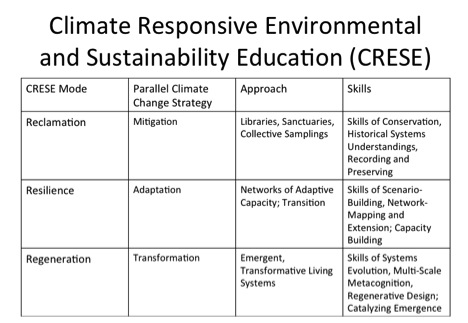
Figure 1. Reclamation, Resilience, and Regeneration as Simultaneous Approaches for Climate-Responsive Environmental and Sustainability Education (own research)
Conclusion
Unlike other models in which components or approaches are competitive, all three Rs are requisite for our multi-system embedded survival and thrivability. As Figure 1 depicts, all three, reclamation, resilience, and regeneration, are ever-more-complex types of capacities and support capacity building aimed together toward life-supportive, dynamic, complex systems transformation. Environmental and sustainability education that fosters skills of reclamation includes preservation, conservation, recording, and the establishment of libraries and sanctuaries of exemplar systems. Environmental and sustainability education for resilience includes network extension and adaptive capacity building. ESE for regeneration nurtures emergent complex systems metacognitions, creativities, and transformative, transgressive social approaches that are connective, disruptive, and innovative and model and embody complex emergence. Regenerative ESE fosters skills to facilitate catalysis of emergent regeneration, self-organization, and transformation into more complex living systems. All of these position embedded learners in pro-active, systems-intensive embodiments of the types of living networks that foster survival, flexibility, and phase-change during our entry into a time of consistent climate turbulence. I would be interested to hear what these three Rs spark in your own educational praxis and action; please share your ideas and comments on the
JSE Facebook Page or contact me directly. In order for environmental and sustainability education to scale to increasingly complex systems, the literacies of reclamation, resilience, and regeneration can help build regenerative urban areas as “cities self-organize…where we are our most creative, collaborative, visionary, artistic, and productive” (Hemenway, 2015, p. 240) and where we can support the emergent self-organization of socio-ecological networks of thriving strengthened by the challenges ahead.
References
- Allen, C. R., Gunderson, L. H., & Holling, C. S. (2010). Commentary on Part One articles. In L. H. Gunderson, C. R. Allen, &C. S. Holling (Eds.), Foundations of ecological resilience (pp. 3-18). Washington, DC: Island Press.
- Bache, C. (2008). Living classrooms. Albany: State University of New York Press.
- Benyus, J. M. (2002). Biomimicry. New York, NY: Harper Perennial.
- Benyus, J. M. (2014). How does nature manage carbon emissions? [Web video]. Let’s reverse climate change together [Web page]. Biomimicry 3.8. Retrieved from http://biomimicry.net/your-challenge-natures-solutions/
- Berkes, F., Colding, J., & Folke, C. (2003). Navigating social-ecological systems: Building resilience for complexity and change. Cambridge, UK: Cambridge University Press.
- Birnbaum, J., & Fox, L. (2014). Sustainable (r)evolution: Permaculture in ecovillages, urban farms, and communities worldwide. Berkeley, CA: North Atlantic Books.
- Bowers, C. A. (2009). Educating for a revitalization of the cultural commons. Canadian Journal of Environmental Education, 14, 196-200. Retrieved from http://files.eric.ed.gov/fulltext/EJ842749.pdf
- Bowers, C. A. (2013). The role of environmental education in resisting the global forces undermining what remains of indigenous traditions of self-sufficiency and mutual support. In A. Kulnieks, D. R. Longboat, & K. Young (Eds.), Contemporary studies in environmental and indigenous pedagogies: A curricula of stories and place (pp. 225-240). Rotterdam: Sense Publishers.
- Brown, V. A., Deane, P. M., Harris, J. A., & Russell, J. Y. (2010). Towards a just and sustainable future. In V. A. Brown, J. A. Harris, & J. Y. Russell (Eds.), Tackling wicked problems through the transdisciplinary imagination (pp. 3-15). New York, NY: Earthscan/Routledge.
- Bullard, R. D., & Wright, B. (Eds.). (2009). Race, place, and environmental justice after Hurricane Katrina: Struggles to reclaim, rebuild, and revitalize New Orleans and the Gulf Coast. Boulder, CO: Westview Press.
- Cajete, G. (2000). Native science: Natural laws of interdependence. Santa Fe, NM: Clear Light Publishers.
- Cajete, G. (2008). Seven orientations for the development of indigenous science education. In N. K. Denzin, Y. S. Lincoln, & L. Tuhiwai Smith, (Eds.), Handbook of critical and indigenous methodologies (pp. 487-496). Thousand Oaks, CA: Sage.
- Capra, F. (2002). The hidden connections: A science for sustainable living. New York, NY: Anchor.
- Crowell, S., & Reid-Marr, D. (2013). Emergent teaching: A path of creativity, significance, and transformation. Lanham, MD: Rowman & Littlefield.
- Davis, B., & Sumara, D. (2008). Complexity as a theory of education. Transnational Curriculum Inquiry, 5(2).
- Edwards, A. R. (2010). Thriving beyond sustainability: Pathways to a resilient society. Gabriola Island, BC: New Society Publishers.
- Folke, C., Hahn, T., Olsson, P., & Norberg, J. (2005). Adaptive governance of social-ecological systems. Annual Review of Environment and Resources, 30, 441-73.
- Goldstein, J., Hazy, J. K., & Lichtenstein, B. B. (2010). Complexity and the nexus of leadership: Leveraging nonlinear science to create ecologies of innovation. New York, NY: Palgrave Macmillan.
- Goleman, D., Bennett, L., & Barlow, Z. (2012). Ecoliterate: How educators are cultivating emotional, social, and ecological intelligence. San Francisco, CA: Jossey- Bass and the Center for Ecoliteracy.
- Gunderson, L. H., & Allen, C. R. (2010). Why resilience? Why now? In Authors & C. S. Holling (Eds.), Foundations of ecological resilience (pp. xiii-xxv). Washington, DC: Island Press.
- Hauk, M. (2013). Five fractal geometries for creative, sustainable, and just educational design [Online proceedings paper]. 96th Annual Meeting of the American Educational Research Association (AERA), San Francisco, California as part of an Interactive Symposium, “The Geometries of Liberation: The Hidden Wealth of Patterns and Materials Outside the Grid,” for Division B, Curriculum Studies, Section 4: Sustainability, Environmental, and Ecological Perspectives. Retrieved from the AERA Online Paper Repository and retrievable from https://www.researchgate.net/publication/259440638_Hauk_M_2013_May_1_Five_fractal_geometries_for_creative_sustainable_and_just_educational_design_Paper_presented_at_the_2013_annual_meeting_of_the_American_Educational_Research_Association_AERA_Conferen
- Hauk, M. (2014a). Gaia e/mergent: Earth regenerative education catalyzing empathy, creativity, and wisdom (Doctoral dissertation). Retrieved from Proquest (UMI 3630295) from http://pqdtopen.proquest.com/doc/1563382491.html?FMT=AI
- Hauk, M. (2014b). Regenerative complex creativity. In D. Ambrose, B. Sriraman, & K. M. Pierce (Eds.), A critique of creativity and complexity – Deconstructing clichés (pp. 97-121). Rotterdam, The Netherlands: Sense Publishers.
- Hauk, M. (2015, June). Catalyzing natural pattern innovation and Gaian collective creativity. Santa Clara, California. Collective Intelligence Conference. Retrieved from http://sites.lsa.umich.edu/collectiveintelligence/wp-content/uploads/sites/176/2015/02/Hauk-CI-2015-Abstract.pdf
- Hauk, M. (2016, April). Theorizing Earth regenerative creativity in education design. Paper in the interactive symposium, Vibrant Earth: Bioculturally Embedded Educational Encounters Catalyzing Earth Regenerative Creativities. 100th Annual Meeting of the American Educational Research Association. Division B: Curriculum Studies, Section 5: Place and Praxis (The Places of Curriculum). Washington, DC.
- Heinberg, R., Sachs, W., & Shiva, V. (2008). Transition strategies. Resurgence (246). Retrieved from http://www.resurgence.org/magazine/article16-transition-strategies.html
- Hemenway, T. (2015). The permaculture city: Regenerative design for urban, suburban, and town resilience. White River Junction, VT: Chelsea Green.
- Holling, C. S., Peterson, G. D., & Allen, C. R. (2008). Panarchies and discontinuities. In C. R. Allen & C. S. Holling (Eds.), Discontinuities in ecosystems and other complex systems (pp. 3-19). New York, NY: Columbia University Press.
- Holmgren, David. (2002). Permaculture principles and pathways beyond sustainability. Holmgren Design Services.
- Ingulli, K., & Lindbloom, G. (2013). Connection to nature and psychological resilience. Ecopsychology, 5(1), 52-55. doi:10.1089/eco.2012.0042.
- Kagawa, F. (2010). Learning in emergencies: Defense of humanity for a livable world. In Author & D. Selby (Eds.), Education and climate change (pp. 106-124). New York, NY: Routledge.
- Kagawa, F., & Selby, D. (Eds.). (2010). Education and climate change: Living and learning in interesting times. New York, NY: Routledge.
- Keating, A. (2013). Transformation now!: Towards a post-oppositional politics of change. Urbana: University of Illinois Press.
- Kenrick, J. (2009). Commons thinking: The ability to envisage and enable a viable future through connected action. In A. Stibbe (Ed.), The handbook of sustainability literacy (pp. 51-57). Totnes, Devon: Green Books.
- Krasny, M. E., Lundholm, C., & Plummer, R. (2010). Resilience in social–ecological systems: The roles of learning and education. Special Issue on Resilience, Learning and Environmental Education. Environmental Education Research, 15(5-6), 463-672.
- Krasny, M. E., Tidball, K. G., & Sriskandarajah, N. (2009). Education and resilience: Social and situated learning among university and secondary students. Ecology and Society, 14(2): 38.
- Kunstler, J. H. (2005). The long emergency: Surviving the converging catastrophes of the twenty-first century. New York, NY: Atlantic Monthly Books.
- Lansing, J. S. (2007). Priests and programmers: Technologies of power in the engineered landscape of Bali. NJ: Princeton University Press.
- Lotz-Sisitka, H., & LeGrange, L. (2010). Climate change education in an era of risk and vulnerability. In R. Irwin (Ed.), Climate change and philosophy: Transformational possibilities (pp. 145-161).
- Lotz-Sisitka, H., Wals, A. E. J., Kronlid, D., & McGarry, D. (2015). Transformative, transgressive social learning: Rethinking higher education pedagogy in times of systemic global dysfunction. Current Opinion in Environmental Sustainability, 16, 73–80.
- Macy, J., & Brown, M. Y. (2014). Coming back to life: The updated guide to the work that reconnects. Gabriola Island, BC: New Society Publishers.
- Macy, J., & Johnstone, C. (2012). Active hope: How to face the mess we’re in without going crazy. Novato, CA: New World Library.
- Mathews, F. (2011). Towards a deeper philosophy of biomimicry. Organization and Environment, 24(4).
- Norris, F. H., Stevens, S. P., Pfefferbaum, B., Wyche, K. F., & Pfefferbaum, R. L. (2008). Community resilience as a metaphor, theory, set of capacities, and strategy for disaster readiness. American Journal of Community Psychology, 41(1-2), 127-150.
- Pelling, M. (2011). Adaptation to climate change: From resilience to transformation. New York, NY: Routledge.
- Russell, J. M. (2010). What is thrivability? (Web chart). Retrieved from http://thrivable.net/philosophy/what-is-thrivability/
- Russell, J. M. (2013). Thrivability: Breaking through to a world that works. Devon, UK: Triarchy Press.
- Selby, D., & Kagawa, F. (Eds.). (2015). Sustainability frontiers: Critical and transformative voices from the borderlands of sustainability education. Opladen, Germany: Barbara Budrich Publishers.
- Soltesova, K., Brown, A., Dayal, A., & Dodman, D. (2014). Community participation in urban adaptation to climate change: Potentials and limits for community-based adaptation approaches. In E. L. F. Schipper, et al (Eds.), Community-based adaptation to climate change: Scaling it up (pp. 214-225). New York, NY: Earthscan/Routledge.
- Sterling, S. (2010). Learning for resilience, or the resilient learner?: Towards a necessary reconciliation in a paradigm of sustainable education. Environmental Education Research, 15(5-6), 511-528.
- Taylor, M. M. (2011). Emergent learning for wisdom. New York, NY: Palgrave Macmillan.
- Williams, D., & Brown, J. (2012). Learning gardens and sustainability education: Bringing life to schools and schools to life. New York, NY: Routledge.
- Wood, J. (2013). Meta-designing for paradigm change: An ecomimetic, language-centred approach. In Stuart Walker and Jacques Giard (Eds.), The handbook of design for sustainability (pp. 428-445). Bloomsbury, New York, NY.
- ZERI. (2015). Zero Emissions Research Initiatives [Web material]. Retrieved from http://www.zeri.org