Showing posts with label just sustainabilities. Show all posts

Friday, January 15, 2021

Fresh publication: "The Verge" - Article on Meta-Method for Collaborative Sense-Making - Applied to Just Sustainability Arts

Note: There is a launch party on January 22, 2021 for this publication, contact Dr. Marna for the information.

It's a pleasure to have this research paper, co-authored with Rachel Kippen, published by Artizein this month. We explore a creative process for collaborative sense-making using arts based methods, and how this approach helped us each deepen in understanding our own just sustainability arts research projects. Kudos to Editor Barbara Bickel and Guest Editor Darlene St. Georges: 

Two sustainability arts scholars describe a method of data interpretation they developed for making sense of complex environmental and sustainability education research data. They “played” images and recorded a conversation in a form of arts-based intersubjective knowing. The card game process was named the Verge because of how the process promises to surface unheard voices and re-center nondominant insights and ways of knowing. It leverages Casey’s glance method with systems networks to complicate sense making in arts-based educational research. The arts scholars intermixed research data from two just sustainability education research case studies: collages from participants of a climate justice social incubator as well as participant art from place-based ecojustice walking pedagogy research. The article engages in intersubjective responding and generated arts-based responses to the process itself. The Verge catalyzed insight in the researchers’ just sustainability arts educational research. They suggest that the Verge could be a useful research method for arts-based educators, particularly sensitive to the ecological and social justice dimensions of data and learning contexts. The researchers found the method helped them gain insight and perspective, sense bias, make subtle connections, sense patterns, decenter domination discourses, and enhance their capacity to engage creatively and critically with social and ecological intelligence in their research process. They posit that the Verge can nurture the unfinished and ongoing work of educational design for just sustainabilities.


Here is a visual and a poem from the synthesis part of the work: 
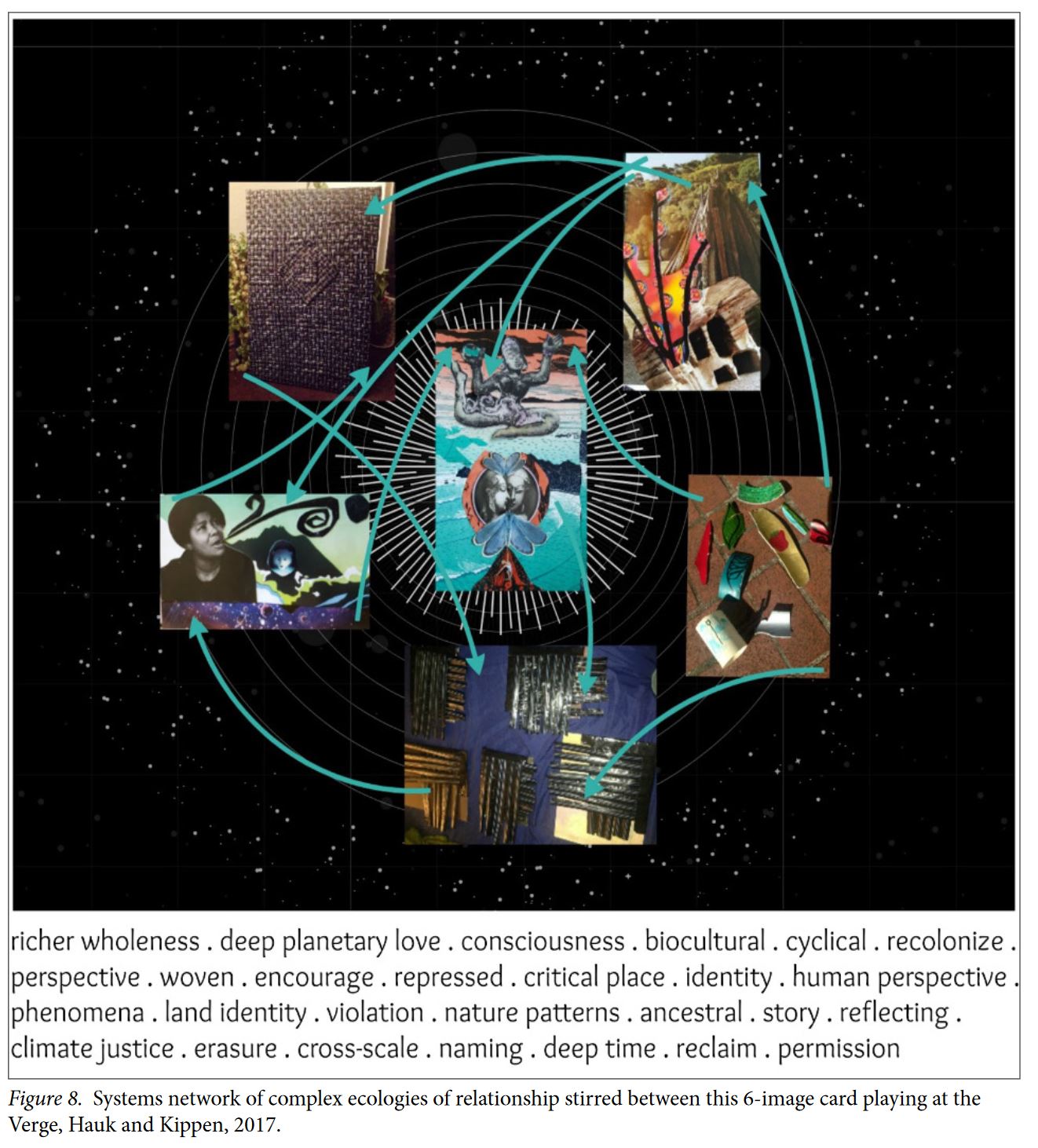


On the Verge


Intersubjective Responding Poem, written by Marna Hauk


nexus of the broken, crazed and braised curation:

knots and nodes explode us out of broken boxes.


verging, the insistence to connect - no, really the break

ing through of the underlying nettlings and mats


imbricating vats of vast connecting. the ribbon works of “fractured seeing” *

are ley lines re-announcing possibilities, the subversive truth


that “what we need / is here. And we pray: not / for new earth

or heaven, but to be / quiet in heart, and in eye / clear.” **


tendrilled rupture of our hallucinated isolation

returning us to intricate netting, nesting, nestling.


this living world of whorled amanuensis, fractal wholes:

whether in a circle, under shade of rowan and walking onion,


or in circles on sand, weaving reclaimed plastic, we touch in

to the greater weavings, through weft of flocks and stones,


warp of stories and names, resurrecting bones, across great spans of time,

dedicated to create sanctuary, for the flourishing of future beings.


“We seek not rest but transformation.

We are dancing through each other as doorways.

We are ripples crossing and fusing, journeying and returning.” ***


let our walking, shaking, slaying of chains and remains

forge a greater quaking, realign the sublime subterranean snaking


until, amplified, returning to the verge of becoming, to ground and body,

we can forever sense earth tendrils and human hands, connecting us to justice.

just us, quivering, in this queer, deep belly invitation to matter, as we embrace

this umbilical, rooted, radical, cloud-weaving, evanescent, essential net-web-braid.


          * Jeanine Canty, 2017, from “Seeing Clearly Through Cracked Lenses”

          ** Wendell Berry, 1985, from “The Wild Geese”

          *** Marge Piercy, from “Circling,” Living in the Open, p. 83


Recommended Citation

Hauk, Marna, & Kippen, Amanda Rachel. (2020). The Verge: Networks of intersubjective responding for just sustainability arts educational research. Artizein: Arts and Teaching Journal, 5(1) , Article 11.  Retrievable from https://opensiuc.lib.siu.edu/atj/vol5/iss1/11 


Friday, May 26, 2017

A response to Heather A. Swanson's "The Banality of the Anthropocene"


This article really reminds me of the a Sustainability Theory and Practice commodity lifecycle assignment, as well as the way that just sustainabilities suggests an inclusive turn to both understand the roots, in the way of environmental racism, the grandmother of just sustainabilities, via environmental justice, as well as inviting us into the future. Just sustainabilities directs our attention and hones our skill at touching in both ways - in the Macyian language, to see both the historical and futurity, the ancestors and the future beings. Agyeman, Bullard, and Evans (2003) argued for this important dimension, noting that “sustainable development requires that we give consideration to our own developmental needs, as well as those of generations still to come" (p. 188).

So when the author Swanson (2017) suggested:

"Donna Haraway has called for curiosity as both scholarly method and political practice, as an antidote to these learned blindnesses. In her book When Species Meet (Haraway 2008), she becomes curious about who and what she touches when she reaches out to pet her dog. That curiosity becomes a radical practice of tracing and inheriting histories, such as the dog-herding practices of livestock-based Australian colonization efforts and the making of purebred dogs. But in a world of structural blindness, such kinds of curiosity do not come naturally. They must be cultivated. But how? How, in the words of Joseph Dumit (2014), do we wake up to connections?

"Can we imagine corollaries to Bible study meetings or consciousness-raising groups in which people would be encouraged to trace the histories of the landscapes they inhabit, a process that might draw them into new ways of seeing themselves and their worlds? I imagine such practices as a multispecies analogue to Foucauldian genealogy (see Foucault 1970). Might exploring the genealogies of Iowa cornfields, for example, denaturalize them and counter the power of their banality? Might they enable Iowans and all of us to become more curious about the conditions of our own subjectivities and, in turn, how we might transform the landscapes with which they are entangled? This is the important work of making curiosity more common, of troubling the Anthropocene." (para. 15-16)
I imagine something extra, too. Thinking of the active hope practices (Macy & Johnstone, 2012), I imagine we can cultivate a way of touching the dog and turn both ways, virtually, in the way the present contains the past AND the future. I can conduct the kind of "multispecies ...Foucauldian geneology" that Swanson suggested (para. 16) as well as touch out and sweep forward, into a potentially regenerative future, how this being, this moment of connection, contact, and conscious shift, how my gaze can become a dedicated glance (in the spirit of Casey, 2007), including a prophetic touching out towards the future beings. Macy and Johnstone described "learning to reinhabit time" (2012, p. 117). Deep time is expansive and invitational.
"Could future generations, for example, discover a way to communicate with us? And if so, what might they say? Perhaps they could only do this if we play our part too by extending ourselves forward in time to meet them. We can do this through our imagination. We don't know whether the communications we would receive this way would be real or imagined -- and we don't really need to know. They still offer useful guidance....By giving future beings a voice, we bring them closer in a way that helps us be guided by their perspective. Hearing ourselves reply to them also helps us to step into a larger view of time" (pp. 158-159).

In this way, I would suggest sustainability and regenerative education invite us to to both/and geneological and futurecasting, future-sensing connectivity and relationality. This sensitization can be sustaining and opening. As Macy and Johnstone suggested,

"We can bring deep time to mind as we go about our daily lives. Even as we wash the dishes, pay the bills, go to meetings, and so on, we can school ourselves to be aware, now and then, of the hosts of ancestral and future beings  surrounding us like a cloud of witnesses. We can remember the vaster story of our planet and let it imbue the most ordinary acts with meaning and purpose. Each of us is an intrinsic part of that story, like a cell in a larger organism. And in this story, each of us has a role to play." (p. 160)
I wish for us each this recombinant and life-giving inclusion of the future beings as well, to sustain us for the work we are called to do, "a cloud of witnesses" (p. 160) and encouragers as we become re-imbricated, re-woven into awareness of the flourishing of the universe in and through us.

This might well help us embody Swanson's invitation, to "become more curious about the conditions of our own subjectivities and, in turn, how we might transform the landscapes with which they are entangled" (2017, para. 16). We might sense that part of this invitation is not only how we might transform these landscapes; it might also be a matter of how these landscapes themselves are transforming us. In a futurecasting of the disintegration of theme parks and the resurging Earth, I imagined a terrapsychological resurgence, "Gaia Taking Back Disneyland" (Hauk, 2016). This involves a collaborative, co-creative re-animation of the living Earth as a co-imaginer of the regenerative possibilities also rippling out from touching the dog. With the land in and through us, with our polychrest capacity to touch out and connect in temporally with what has been wrought and what the future beings are summoning us to, I ask: What stories of the regenerative future are you touching into, carrying, and birthing?

References

Agyeman, Julian, Bullard, Robert D., & Evans, Bob. (Eds.). (2003). Just sustainabilities: Development in an unequal world. Cambridge, MA: MIT.
Casey, Ed. (2007). The world at a glance. Bloomington: Indiana University Press.
Hauk, Marna. (2016). Gaia taking back Disneyland. In Julie C. Garlen & Jennifer A. Sandlin (Eds.), Teaching with Disney (pp. 149-160). Counterpoints, 477. New York, NY: Peter Lang.
Macy, Joanna, & Johnstone, Chris. (2012). Active hope: How to face the mess we're in without going crazy. Novato, CA: New World Library.
Swanson, Heather A. (2017, February 22). The banality of the Anthropocene. Dispatches. Cultural Anthropology. Retrieved from https://culanth.org/fieldsights/1074-the-banality-of-the-anthropocene


Image Reference 
Morrison, Geoffrey. (2014, February 11). Hobbiton, New Zealand. CNET. Retrieved from https://www.cnet.com/pictures/take-a-tour-of-hobbiton-pictures/37/

Tuesday, July 26, 2016

Spectrum of Inclusive Resilience: Designing and Assessing Climate Justice Education

In 2014, I took a course on "Measuring Environmental Education Outcomes" with Marianne Krasny and Alex Kudryavtsev, through EE Capacity, NAAEE, and Cornell University Civic Ecology Lab. For this course, I developed a three-tiered spectrum instrument that faculty and teachers could use to assess the level of inclusion of climate justice considerations in their curriculum. The intention was this would support teachers in designing for deeper integration of climate justice education in their courses.

In October 2014 I developed a visualization for this instrument and presented it as one of the Community Climate Change Fellows of NAAEE in Ottawa, Canada. In the following year, I refined the instrument, inspired by my experiences teaching doctoral students climate change education and mentoring graduate students in environmental justice and just sustainabilities. In October of 2015, I revised the instrument and was selected to present it at the Research Symposium of the North American Association for Environmental Educators. Now available are a companion briefing about the instrument as well as an informational poster. I am still in the process of further refining and articulating this work for academic publication.


Figure 1. Snapshot, Spectrum of Inclusive Resilience Poster (Hauk, (c) 2015)

Title: Spectrum of Inclusive Resilience: Designing and Assessing Climate Justice Education 

Abstract: Developed by meta-synthesis and refined by multi-case application, this research offers a three-tier spectrum to assess and design for depth of implementation of transformative climate justice approaches in curricula and projects, to avoid greenwashing and move more deeply towards social transformation, community-based action, inclusion, and resilience in environmental education.

Marna Hauk, Ph.D. – NAAEE – Research Symposium – October, 2015 in San Diego, California

Here's the handout I shared with visitors during the discussion.
Here's the poster I developed to share this instrument - more refined than the 2014 one, and still in formation.

Hope you find it of interest, and please let me know what you see missing or would suggest augmenting or changing. I have subsequently encountered the work of the Hackman Consulting Group on designing climate justice education, whose insights I hope to include in the next iteration of this spectrum model.

Thank you.